|
The UNIVAC 1219B is a medium-scale,
general-purpose military digital computer built by Sperry Rand's UNIVAC
division in the mid-1960s. It was the "radar in, missile out" brain of shipboard
fire control: computing real-time targeting solutions for the
Terrier, Talos, and
Tartar surface-to-air missile systems in the era of
the Vietnam War. Only two 1219B systems are known to survive today (both owned by InfoAge), and
one of them (serial #8) still runs!
That one lives at InfoAge Science and History
Museums at historic Camp Evans in Wall Township, New Jersey —
and I'm its operator along with Bill Dromgoole. My name is Steven
Schiavone, and since 2021 I have maintained, repaired, and
demonstrated this machine to the public. I am one of only three people in
the world who know how to run this UNIVAC, and at a couple generations
younger than my esteemed colleagues, I intend to keep it running for decades
to come. This page is my collection of everything I know, use, and love about
the machine.
Apart from Bill, the man who calls the shots is Duane Craps, a gentleman
from Virginia who spent his entire 40-year career working with these machines. Before
we had young programmers come by with Rust and C and RISC, Duane wrote every program,
smithed every Arduino to translate from NTDS slow to serial, and continues to STILL
be the one to call when the machine has issues. Duane, to put it simply, is a more
authoratative source than any of our shelves of bulging binders ever could be.
|
|
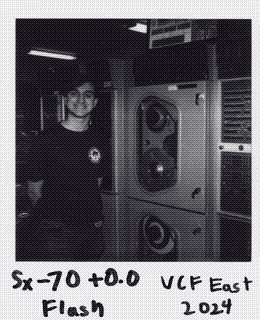
Me & the UNIVAC 1219B at VCF East 2024
Shot on Polaroid SX-70
|
|
 What Is the UNIVAC 1219B (And Some Context for its Era) What Is the UNIVAC 1219B (And Some Context for its Era)
|
|
The 1219 family was Sperry UNIVAC's follow-on to the UNIVAC 1218, part of
a line of ruggedized 18-bit military computers. Where most warships of the
era still aimed their weapons with analog gun directors, the UNIVAC 1219
brought digital computing to the fleet — it was the first digital
computer aboard most of the U.S. Navy ships that carried it. However, two chassis
to the right of the main is a DAC (digital to analog converter). The Navy "craved
the strength and certainty of [digital]" over analog computers, they did not want
to replace everything on their ship with digital should it be shown to be less
reliable. Therefore, a DAC was needed to interface with the analog radars and
missile systems.
The "B" model arrived in the mid-1960s as an improved 1219, and in Navy
fire-control service the machine is associated with the Mk 152 or CP-848
designation (and a 5840-00-110-5021 National Stock Number). This steel beheamoth
containes features most computers today lack, shock-mounted cabinets with springy
feet, screw-locked modules, battleshort switches
that bypass every protective fuse so the computer can keep firing while it
burns itself to ash, and power drawn from a ship's 400-cycle supply.
It is not small. The CPU cabinet alone weighs roughly 1460 pounds,
and the UNIVAC 1540 DDR (digital data recorder) adds another 1700 pounds.
But it was a seriously powerful machine built for very serious work. But
what fascinates my post-y2k mind in the gulf between machines like this
made for serious work and computers made for much less serious work.
In 1968, the closest thing to a personal computer was a programmable calculator: the Hewlett-Packard HP-9100A. To understand its processing power, we can calculate its MIPS (Million Instructions Per Second). Running at 1 instruction per 0.002 seconds yields 500 instructions per second, or roughly 0.0005 MIPS.
- HP-9100A (Personal): $5,000 USD | 40 lbs | 0.0005 MIPS | 0.25KB storage
- UNIVAC 1219B & 1540 (Enterprise): $400,000 USD | 3,160 lbs | 0.5 MIPS | 26.09MB storage
When upgrading from the HP to the UNIVAC, what you got for the price increase was staggering (for a 79× weight increase, stagering is the best word). For an 80× cost increase, users gained a 1,000× boost in processing speed and an incredible 106,864× increase in storage capacity.
Let us compare it against today's consumer and enterprise systems (we're converting GPU FLOPS to MIPS, btw).
- Maingear MG-1 (Personal): $2,749 USD | 30 lbs | 30,943,250 MIPS (103,250 CPU + 30,840,000 GPU) | 2TB storage
- Nvidia DGX H100 (Enterprise): $410,000 USD | 287.6 lbs | 31,664,653,234 MIPS (31.66B from quad-H100s + 653K from dual Xeons) | 36.24TB storage
Comparing the modern personal system to the 2026 enterprise solution reveals a different scaling dynamic than the 1960s. Today, a 149.2× increase in price and a modest 9.6× increase in weight yields a 1,023.3× increase in speed and an 18.1× increase in storage. While this is impressive, this is a similar jump in performance seen in 1968 but at nearly double the price scale!
|
UNIVAC 1219B (7049747-11) Technical Specifications |
| Dimensions |
72 inches high, 38 inches wide, and 29 inches deep at 1,460 pounds. |
| Clock |
500 ns four-phase master clock (2 MHz), four cycles per 2 µs memory cycle; ~0.25‐0.5 MIPS on 18-bit words. |
| Main memory |
40,960 18-bit words (40K) of coincident-current magnetic core, 2 µs cycle, 750 ns read access. Equal to approximately 90KB. |
| Bootstrap (NDRO) memory |
32 words of unalterable non-destructive-readout core, 2 µs cycle. Permanently stores the initial-load bootstrap, with loaders for paper tape and magnetic tape at 00500-00537. |
| Real-time clock |
Lives in control memory; resolution 1/1024 second (just under a millisecond) |
| I/O Channels |
16 channels, all slow (‐15 VDC) interface, in two 8-channel groups (octal 0‐7 and 10‐17). |
| Transfer rate |
41,667 words/s (0.75 Mbit/s) single channel, 83,334 words/s (1.5 Mbit/s) dual channel (36-bit), 166,667 words/s (3.0 Mbit/s) multi-channel maximum. |
| Operating environment |
0° to 50°C, humidity to 95 percent. |
| Non-operating environment |
-62° to 75°C.
According to the NIH, cell tissue freezes in under 60 seconds at this temp. It is two degrees warmer than the record-low temperature in Yakutsk, Russia (-64.4)!!! And the storage high is 18.3°C above the hottest official air temperature ever recorded in the world in 1913 in Death Valley! |
| Power requirements |
Two 115 VAC, 400 Hz, 3-phase feeds ±1% for logic, ±10% for blowers. Maximum draw is 2,300 W for this 40K/16-channel configuration. |
| Software |
TRIM I, II, and III, plus C running on our RISC-V toolchain! |
|
UNIVAC 1540 Magnetic Tape Unit Technical Specifications |
| Dimensions |
72 inches high, 38 inches wide, and 30 inches deep at 1,700 pounds. |
| Tape |
"A" wound (oxide coating faces inward), up to 3,600 feet (1.097km) per reel of tape. |
| Tape speed |
120 inches per second read/write; 240 ips rewind. |
| Start / stop time |
3 ms start, 1.5 ms stop. |
| Density |
200, 555.5, or 800 frames per inch (a full 3,600-foot reel comes to roughly 6.5, 18, or 26 MB). |
| Transfer rate |
96,000 characters per second at high density (72 KB/s), 66,700 at medium (50 KB/s), 24,000 at low (18 KB/s). |
| Operating environment |
0° to 50°C operating, -62° to +75°C non-operating, humidity up to 95 percent. |
| Power requirements |
1.8 kVA of 115 V ±10% single-phase 60 Hz plus 0.6 kVA of 115 V ±5% 3-phase 400 Hz. |
| Cooling |
600 cubic feet per minute of 70°F air. |
|
UNIVAC 1532 Input/Output Console Technical Specifications |
| Dimensions |
49 inches high, 23 inches wide, and 29 inches deep at 300 pounds. |
| Operating environment |
0° to 50°C operating, -62° to 75°C non-operating, humidity up to 95 percent. |
| Primary power, logic |
115 VAC ±11.5 (line to ground) or 208 VAC ±20.8 (line to line), 400 Hz ±20 Hz, 3-phase, 250 W. |
| Primary power, motor |
115 VAC ±11.5, 60 Hz ±3 Hz, single-phase, 600 W. |
| Power supplies |
Logic: 100 W in, -4.5 / -15 / +15 VDC out.
Keyboard/printer and paper tape punch: 150 W in, -28 VDC out.
Fun fact! Our InfoAge 1532 was the first piece of the puzzle we ever got working! It was repaired before we had the 400Hz generator, so it has been modified to run fully on 60Hz. |
| Teletypewriter dimensions |
15 inches high, 28 inches wide, and 25 inches deep at 120 pounds. |
| Teletypewriter power |
115 VAC ±11.5, 50 to 60 Hz. |
| Transmission rate |
100 words per minute nominal, 9.09 ms per bit (110 baud). |
| Page capacity |
10 characters per inch, 72 characters per line; 6 lines per inch single-spaced, 3 double-spaced. |
|
Our Machine at InfoAge |
|
Our system was rescued by Bill Degnan around y2k by the Vintage
Computer Federation and brought to Camp Evans, the military installation
where Project Diana bounced the first radar signal off the Moon in
1946 (and what I 100% believe Captain America's Camp Lehigh is IRL). The full first-hand
account of the rescue is preserved in this vintagecomputer.net forum thread.
The installation is a complete five-piece system:
 UNIVAC 1219B ‐ the CPU itself. UNIVAC 1219B ‐ the CPU itself.
UNIVAC 1540 ‐ the tempermental DDR.
Converter Signal Data MK 75 ‐ the DAC.
UNIVAC 1532 ‐ the input/output console.
Teletype Model 35 KSR ‐ the teletype (TTY) hooked up to the 1532.
One weekend a month (or so we try), we run and demo the machine for museum
visitors. Every spring, we also demonstrate it at
Vintage Computer Festival East (VCF East)
for hundreds of visitors. Every year we show something new, be it
a new DDR tape handler diagnostic demo, ASCII art, or some incredible software someone
has programmed for it.
Development for Exotic Big Iron
Programming new software for the 1219B is unlike anything you encounter today:
18-bit words, ones' complement arithmetic, dog slow...everything. That didn't stop a 2026
project by Nathan Farlow and The Science Elf that built a
Rust-based RISC-V emulator for the machine, letting it run modern C
programs and, absurdly, a
Minecraft server. I supported the project with
machine wrangling, debugging, and general operation on the 1219B side. Read the
full
write-up at farlow.dev or watch
the video documentation
on YouTube.
|
Frequently Asked Questions |
Does the UNIVAC 1219B actually run?
Yes! The the 1219B, 1532, and the Teletype all work very well (although the 1219B has its good
points and bad days). The UNIVAC 1540 does indeed work...to an extent. Tape handler one was reliable
until a tape blew up on it and tape handler two's back/rewind caster has never worked quite right.
It powers on and the motors run, but we are in the thick of electromechanical hell with it.
Can I see it run?
Yes. Visit InfoAge Science and History Museums at Camp Evans, Wall
Township, New Jersey. We (try to) run the machine for visitors one weekend a month,
and every year at VCF East. If you're interested in making the trip for the UNIVAC,
let me know and I can tell you the next time we're scheduled to have it running.
What can it actually run today?
Original diagnostics and demonstration programs, loaded via paper tape,
plus, thanks to the RISC-V project, modern C programs and one gloriously
slow Minecraft server or NES emulator.
What year did the 1219B come out?
Every time I look into it, I get a different answer. I will claim 1965 as that is what is stated on VIPclub, but I'm very open to correction.
|
UNIVAC 1219B Resources |
UNIVAC 1219B Paper Documentation
bitsavers.org — Original Sperry UNIVAC Manuals
Scanned PDFs of the original technical and operator manuals for the UNIVAC 1219B, including the Mk152 instruction manual. Indispensable reading for anyone interested in 1960s naval fire-control computers.
|
Manuals
|
UNIVAC 1540 DDR Tape Drive Documentation
bitsavers.org — Original Sperry UNIVAC Manuals
Paper documentation for the UNIVAC 1540 digital data recorder — the tape drive peripheral that Bill and I are currently restoring at InfoAge.
|
Manuals
|
UNIVAC 1219B and 1540 Demonstration
YouTube — Video Demo
My walkthrough demo of the UNIVAC 1219B mainframe and the 1540 digital data recorder at InfoAge, showing the machine in operation along with its peripherals.
|
Video
|
UNIVAC 1219B on Tumblr (@univac1219)
tumblr.com — The Machine's Own Blog
The photo-and-progress blog I keep for the machine itself: restoration snapshots, core memory close-ups, and life at the museum.
|
Blog
|
How the UNIVAC 1219 Was Acquired
vintagecomputer.net — Forum Thread, circa 2010
A first-hand account from the vintage computing community describing how this particular UNIVAC 1219 system was rescued and brought to InfoAge for preservation.
|
Forum
|
Teletype Model 35 Typebox Font (TS-101)
github.com — TrueType Digitization
Download the lettering of our Teletype Model 35's TS-101 typebox as TrueType fonts.
|
Fonts
|
|
|
|